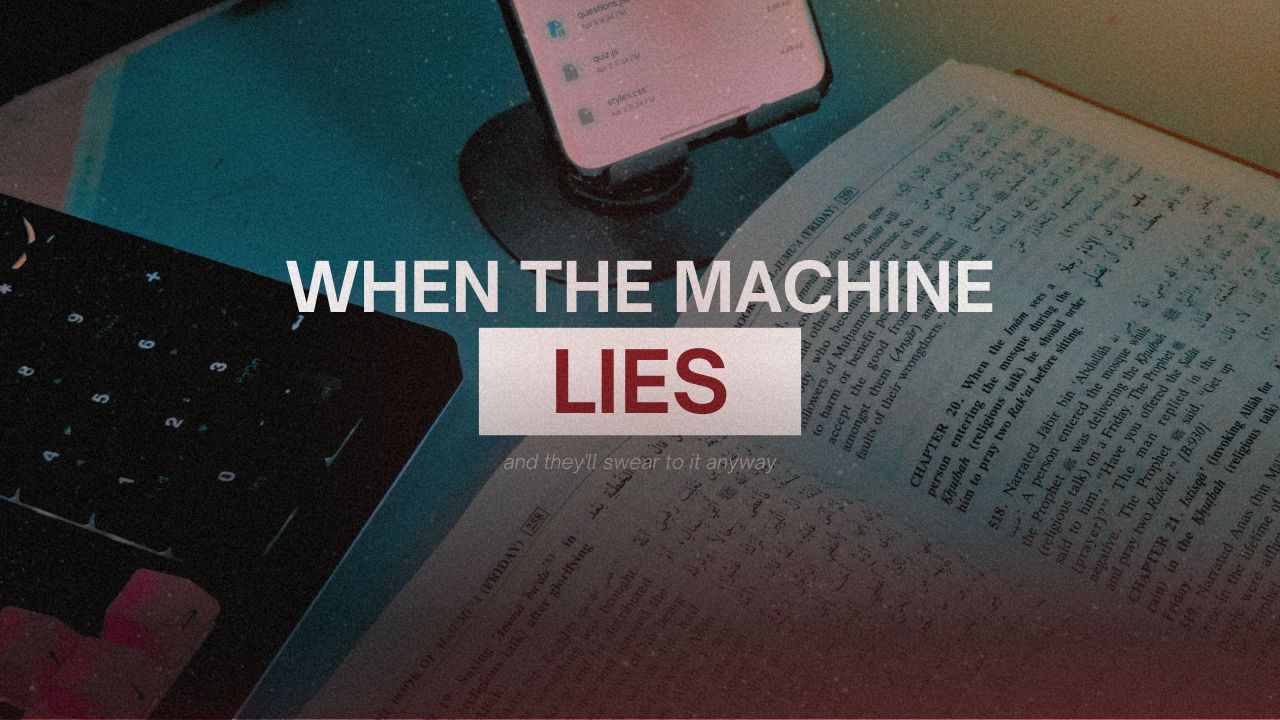
When the Machine Lies: AI Hallucination, Misinformation and the Cost to the Ummah
Large language models don't know what they don't know and they'll swear to it anyway.

format_list_bulleted Table of Contents
السلام عليكم
If you've spent any time with a chatbot lately, you already know the feeling. You ask it a question, it answers with absolute, unblinking confidence and somewhere in the middle of the third paragraph you realize: this is completely made up.
That confident lie has a name. We call it a hallucination. And as someone who learns machine learning, I want to explain why this isn't just a technical bug. For the ummah a community whose entire deen rests on the integrity of knowledge it's one of the most important problems of our generation.
What Is a Hallucination, Really?
When we say a language model "hallucinates," we don't mean it's confused. We mean it did exactly what it was trained to do: predict the next most plausible token. Plausible is not the same as true. The model has no concept of fact it has a concept of fluency.
A model that sounds right and a model that is right are two completely different systems wearing the same coat.
This is the uncomfortable truth that marketing copy never mentions. The same architecture that can summarize a 200-page research paper will, without flinching, invent a court case that doesn't exist, attribute a quote to a scholar who never said it or fabricate a hadith with a perfectly formatted isnad chain.
From Hallucination to Misinformation
Here's where it gets dangerous. A hallucination on its own is just a wrong answer. But we don't consume these answers in isolation. They get:
- Screenshotted and shared into WhatsApp groups before anyone reads the full thing.
- Translated into Arabic, Japan, Malay, Mandarin losing the few hedges that existed in the original English.
- Republished as infographics, then short-form video, then "everyone knows that..."
The pipeline from hallucination to conventional wisdom is shorter than it has ever been in human history. Misinformation used to require a motivated liar. Now it just requires a confident machine and a reader who doesn't check.
كَفَى بِالْمَرْءِ كَذِبًا أَنْ يُحَدِّثَ بِكُلِّ مَا سَمِعَ
"It is enough of a lie for a person that he narrates everything he hears."
— Prophet Muhammad ﷺ · reported in Sahih Muslim & Sunan Abi Dawud
This isn't a new problem the Prophet ﷺ couldn't have foreseen. He diagnosed the root fourteen centuries ago. The disease isn't the machine, it's us, narrating everything we hear with no chain behind it. The machine just gave the old habit industrial scale.
The Literacy Gap
Every new medium punishes the unlettered. The printing press did. Television did. The internet did. AI is doing it again but only faster and dressed up as a helpful assistant.
What's changed is the style of literacy required. Reading used to mean decoding letters. Then it meant evaluating sources. Now it means holding a fluent, polite, confident voice at arm's length and asking: where did this come from and why should I believe it?
That's a hard skill. Most of us — myself included — were never trained for it. And the gap between those who have it and those who don't is widening every month.
Why This Hits the Ummah Harder
I want to be honest about why I'm writing this for a Muslim audience specifically and not as a generic tech-ethics post.
Our tradition is built on the most rigorous information-verification system ever devised by humans — the isnad, the chain of transmission. A scholar wouldn't narrate a single sentence without knowing who heard it from whom, all the way back. Lives were spent on this. Books were written just to catalog unreliable narrators.
And now we live in an age where the same ummah will paste a fabricated fatwa from a chatbot, share an AI-generated "quote" from a deceased scholar or build a religious argument on a verse reference that doesn't exist because the machine sounded authoritative and we were too tired to open a mushaf.
The same community that invented the isnad now forwards things with no chain at all, because an algorithm with no name said so.
That should sting. It stings me. And it should make us serious, not cynical.
The Specific Dangers
- Fabricated religious texts — invented hadith with real-looking references or real verses attached to invented meanings.
- Fake scholars — deepfake video and cloned audio of du'aat saying things they never said.
- Confident fatawa — AI issuing rulings on sensitive matters (divorce, finance, 'aqeedah) with no scholar and no usul behind it.
- Polarization — AI-generated content designed to inflame divisions within the ummah, because outrage is what the engagement model rewards.
None of this is hypothetical it has already happened. In June 2026, a dakwah book called Wanita Syurga, written by social-media personality Aisyah Hijanah, was found to contain Qur'anic verses, translations and hadith that did not match the original sources fabricated text printed as revelation. Photos of the pages went viral; JAKIM opened an investigation; the author publicly apologized and pulled the entire print run off the market. Her explanation? She hadn't checked her own ghostwriter's writing. A physical book written slowly, edited, "proofread" still slipped fabricated verses past everyone, because no one in the chain actually opened a mushaf to verify.
And it isn't only influencers. Late in 2025, even JAKIM Sabah the very department entrusted with safeguarding the Qur'an's text was publicly called out for presenting a "verse" attributed to Surah an-Nisa that does not exist in the Qur'an at all. If the institution paid to protect the revelation can accidentally publish a fabricated verse, what do you think a chatbot will do — a chatbot with no board, no review and no fear of Allah?
What Do We Actually Do?
I'm an engineer, so I won't end on doom. Here's a practical stance I think every Muslim who touches this technology should adopt.
Treat AI as a fast reader, not a knower
It's brilliant at summarizing, drafting and translating things you then verify. It is dangerous the moment you let it be the final word. Use it as a draftsman, never as an authority.
Restore the isnad instinct
Before you forward anything — a fatwa, a quote, a news claim — ask the old question: who said this and through whom? If the only source is "the AI told me," that's not a source. That's a guess in a suit.
Build literacy, especially among the elders and the young
The two most exposed groups are our parents (who trust fluent authority) and our kids (who've never known a world without it). Sit with them. Show them a hallucination happen in real time. Demystify the magic. Once you've seen a machine invent a fake citation, you can't un-see it.
For the builders among us: build for trust
If you're a developer, a data scientist, a designer — this is your fight. Citation, provenance, retrieval-augmented generation, watermarking, source-grounded answers. The ummah needs tooling that assumes the reader deserves a chain of transmission, not just a confident paragraph. Build the isnad back into the machine.
والله أعلم
References
- Hadith: "It is enough of a lie for a person that he narrates everything he hears." — Dorar.net, Sharh al-Hadith 26146.
- Free Malaysia Today — "Jakim siasat dakwaan silap ayat al-Quran dalam buku 'Wanita Syurga'" (28 Jun 2026).
- Berita Harian — "JAKIM siasat kontroversi buku 'Wanita Syurga'".
- mStar — "Aisyah Hijanah tarik balik buku 'Wanita Syurga'" (26 Jun 2026).
- Malaysiakini — "Kecoh isu ayat al-Quran tak tepat dalam buku nukilan…" (2 Jul 2026).
- JAKIM Sabah / Surah an-Nisa incident (Nov 2025) — surfaced via public commentary, e.g. flag on the non-existent verse attributed to Surah an-Nisa.
- Vosoughi, Roy & Aral — “The spread of true and false news online,” Science (2018).