Sub-1 Nanometer Chip Technology
How smaller can it gets?

.jpg)
format_list_bulleted Table of Contents
السلام عليكم
Angstrom?
Chipsets are available in all our daily lives. Now, IBM has presented a new technology in the semiconductor industry which is the world's first sub-1 nanometer (nm) chip technology. They claim this is designed at a 0.7 nm or 7 Angstrom node.
This shows that Moore's Law is still ongoing and not yet dead (or false), because some skeptics only look at this on a 2D plane or what we can call a flat surface. But IBM proves that while you reach the horizontal limits, the path for the future is basically to look up. get it?

The figure above shows what stacking looks like and how small they are.
What is Moore's Law?
Moore's Law is basically the claim that transistors on a chip can keep on shrinking, doubling in count roughly every 2 years. While some said it is going to hit its limit and to be fair, it probably would at some point, but we never know—when the production scaling was thought to be declining, IBM proved them wrong.
IBM's breakthrough relies on a new architecture called "Nanostack", which is the first known three-dimensional (3D), nanosheet-based design. Instead of placing transistors side-by-side:
- Transistors are stacked and staggered vertically using 3D sequential integration.
- Different layers can utilize distinct material combinations, optimized independently for performance or energy savings.
- It crams nearly 100 billion transistors onto a fingernail-sized piece of silicon, effectively doubling the density of IBM's 2 nm chip from 2021.
While the physical limits of scaling are challenging, IBM claims that Moore's Law could possibly survive another decade. The Law hasn't died yet; it is still climbing.
To show the historical precision of the ~2-year cycle predicted by Moore's Law, we can track the growth of transistor counts from the birth of microprocessing to today's cutting-edge:
- 1971 (Intel 4004 - 10 µm): 2,300 transistors
- 1974 (Intel 8080 - 6 µm): 4,500 transistors
- 1978 (Intel 8086 - 3 µm): 29,000 transistors
- 1982 (Intel 80286 - 1.5 µm): 134,000 transistors
- 1985 (Intel 80386 - 1.5 µm): 275,000 transistors
- 1989 (Intel 80486 - 1 µm): 1.18 million transistors
- 1993 (Intel Pentium - 800 nm): 3.1 million transistors
- 1997 (Pentium II - 350 nm): 7.5 million transistors
- 2000 (Pentium 4 - 180 nm): 42 million transistors
- 2004 (Pentium 4 Prescott - 90 nm): 125 million transistors
- 2006 (Core 2 Duo - 65 nm): 291 million transistors
- 2008 (Core i7 Nehalem - 45 nm): 731 million transistors
- 2012 (Intel Ivy Bridge - 22 nm): 1.4 billion transistors
- 2016 (Apple A10 - 16 nm): 3.3 billion transistors
- 2018 (Apple A12 Bionic - 7 nm): 6.9 billion transistors
- 2020 (Apple A14 Bionic - 5 nm): 11.8 billion transistors
- 2024 (Apple A18 Pro - 3 nm): ~20 billion transistors
- 2026 (IBM 0.7nm Prototype - 0.7 nm): ~100 billion transistors
Visualizing 55 Years of Scaling with Python
To map this historical progression accurately, we generated our custom visualization using matplotlib and numpy. Because transistor counts scale exponentially, we fit a linear regression to the logarithm of the transistor counts. Here is a look at the core plotting logic used:
import matplotlib.pyplot as plt
import numpy as np

years = [1971, 1974, 1978, 1982, 1985, 1989, 1993, 1997, 2000, 2004, 2006, 2008, 2012, 2016, 2018, 2020, 2024, 2026]
counts = [2.3e3, 4.5e3, 2.9e4, 1.34e5, 2.75e5, 1.18e6, 3.1e6, 7.5e6, 4.2e7, 1.25e8, 2.91e8, 7.31e8, 1.4e9, 3.3e9, 6.9e9, 1.18e10, 2.0e10, 1.0e11]
# Then you can add those chipset as well and other info.

fig, ax = plt.subplots(figsize=(18, 12))

# Fit linear regression to log10(counts)
log_counts = np.log10(counts)
slope, intercept = np.polyfit(years, log_counts, 1)
regression_counts = 10**(slope * np.array(years) + intercept)

# Plot trendline and actual scatter points
ax.plot(years, regression_counts, color="#4D7C0F", linestyle="--", label="Regression Trendline")
ax.scatter(years, counts, color="#84CC16", edgecolor="#4D7C0F", s=90, label="Actual Data")
ax.set_yscale('log')

# Then so on...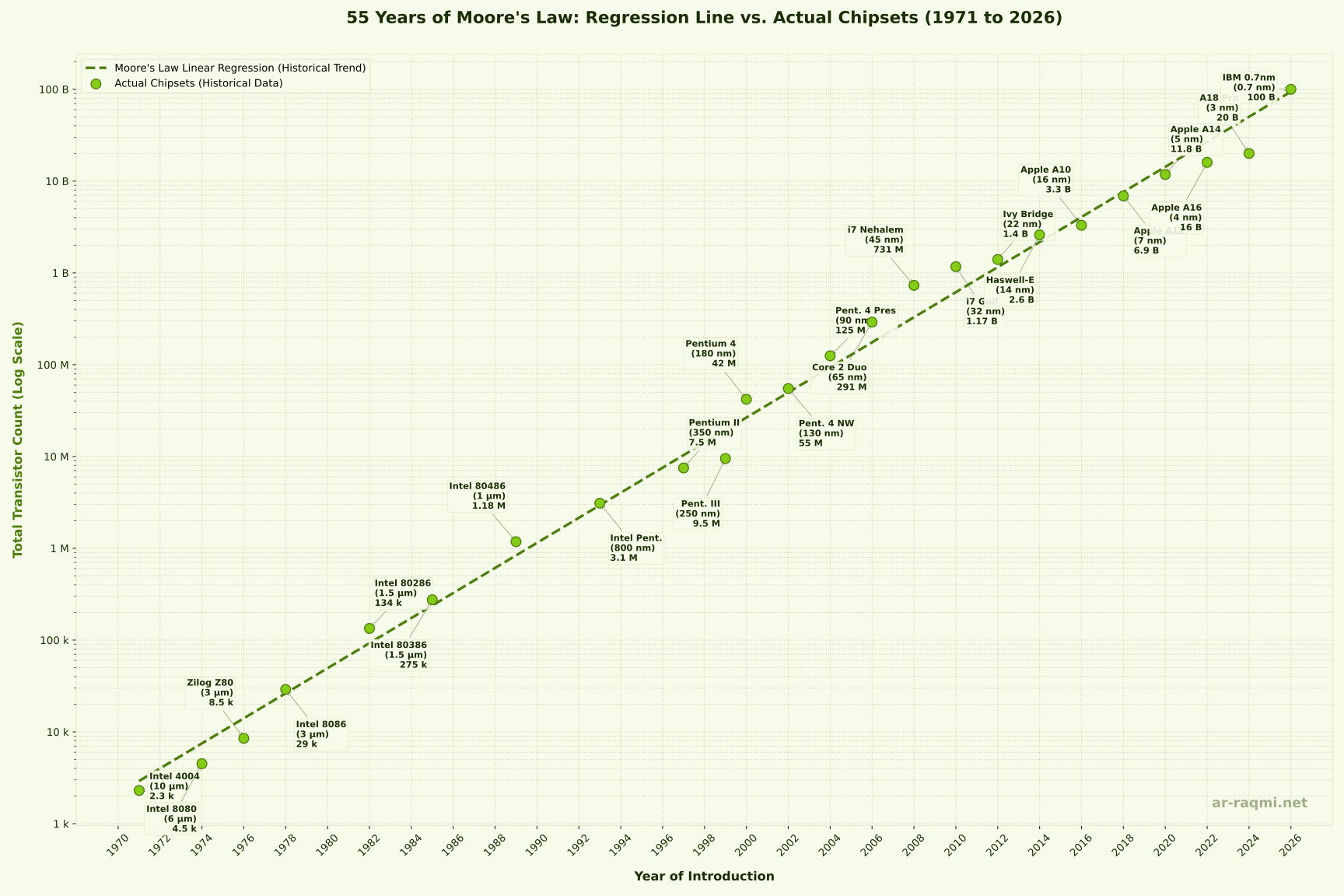
My perspective on this
This is going to be very huge in upcoming technology. The reason being, I always favor ARM chipsets (well, basically all chipsets are going to get affected, but ARM is where it shines). ARM chipsets have such low power consumption and are incredible for battery life.
I use a MacBook and compared to any other laptop I've used—doesn't matter if I install Linux or Windows—their battery still cannot top the usage of a MacBook's Apple Silicon. Seeing how Apple's Silicon worked out shows us that this new 0.7 nm node is going to take efficiency to another level.
Specifically, this makes running local AI models on devices like smartphones, small IoT devices and laptops highly possible. With IBM projecting a 70% energy efficiency gain and a 40% scaling in SRAM, we will have the speed and battery life needed to keep private AI models running right in our pockets.
والله أعلم
References
- Sub-1nm Chip Announcement: IBM Newsroom
- Moore's Law History & Dataset: Wikipedia
- Transistor Architecture Specifications: WikiChip
- Legacy Intel Specifications: Intel Museum