What Happens When AI Has Read Everything Humans Ever Wrote?
The real bottleneck is not compute. It is the finite stock of human wisdom.

format_list_bulleted Table of Contents
السلام عليكم
There's a number the AI industry don't like to talk about and it's not a capex figure. It's the amount of real, human-written text left on Earth that nobody scraped yet.
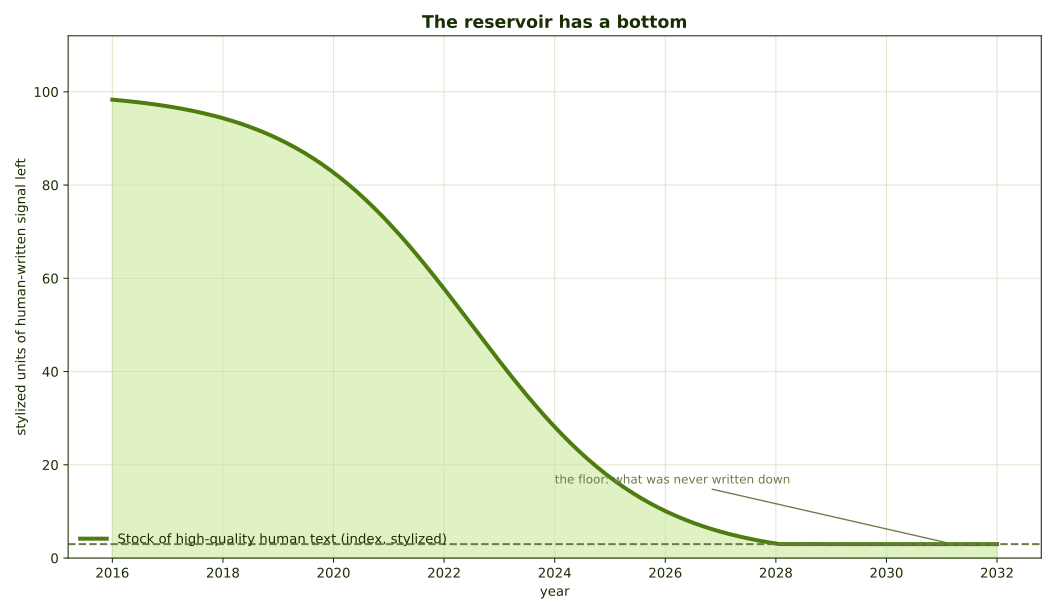
Every question you ask a large language model gets answered out of a reservoir that was mostly filled years ago. The public web, books, code repos, forum threads and the archives of everything people bothered to type before it became someone's training set. The entire AI boom is a drawdown on that reservoir. And the reservoir has a bottom.
So the question that's quietly spreading through data teams in 2026 is less dramatic than "will AGI kill us?" and more practical: once human knowledge is exhausted, where does AI get its data?
You compute the answer wrong. It isn't "nowhere, so AI stalls." It's "everywhere weird" and the hunt for it is already underway.
The hidden bottleneck
Go back a few years and the AI story was about compute. Buy more GPUs, train a bigger model, watch capability curve upward. Why it worked? because the cheap part of the equation, data, was just sitting there. The open web was a buffet nobody thought to gate.
That era is ending. Not because compute got scarcer, but because the data that used to be free got expensive in a way money doesn't fully fix. It got finite.
Consider what the market is actually telling us. Open-weight models are being downloaded by the billions (Alibaba's Qwen recently crossed the three-billion-download mark, passing Meta and Google). That hunger for cheap, capable models doesn't exist because data is abundant. It exists because the race is now about who can squeeze more from less. Every lab wants the same limited stock of genuinely good human text and they're bumping elbows.
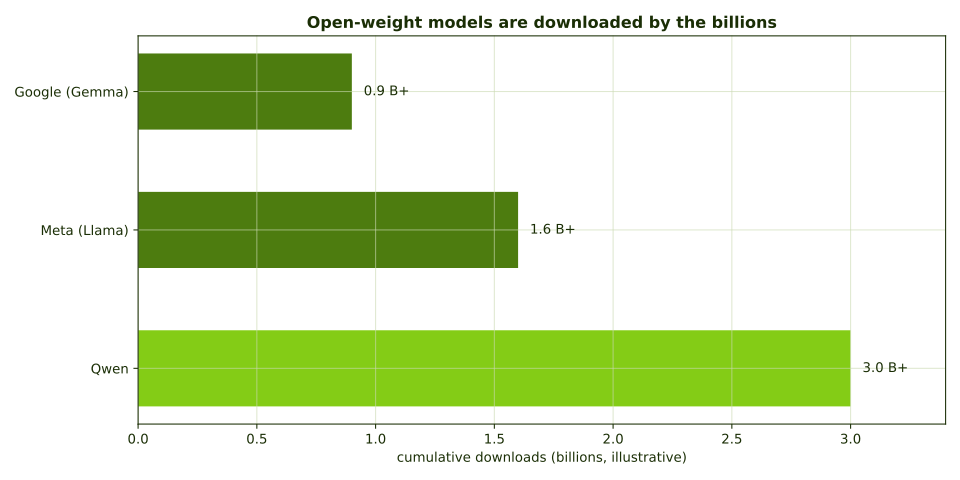
Open-weight models are downloaded by the billions.
Compute can be acquired. You can't acquire ten more Humans-of-Earth with a purchase order.
The inbreeding problem
Here's the honest, slightly uncomfortable part: the web the next model gets trained on is no longer a web written mostly by humans. It's a web increasingly written by models. Product copy, SEO blogs, code suggestions, forum replies, summaries of summaries and yes, this kind of piece too.
When you train a model on text that was itself written by models, you get distribution collapse. Think of it like inbreeding: the population narrows, outliers wash out and the model ends up polishing the average of its own past outputs instead of learning anything new. It gets more confident about what it already knows and less able to say anything worth adding.
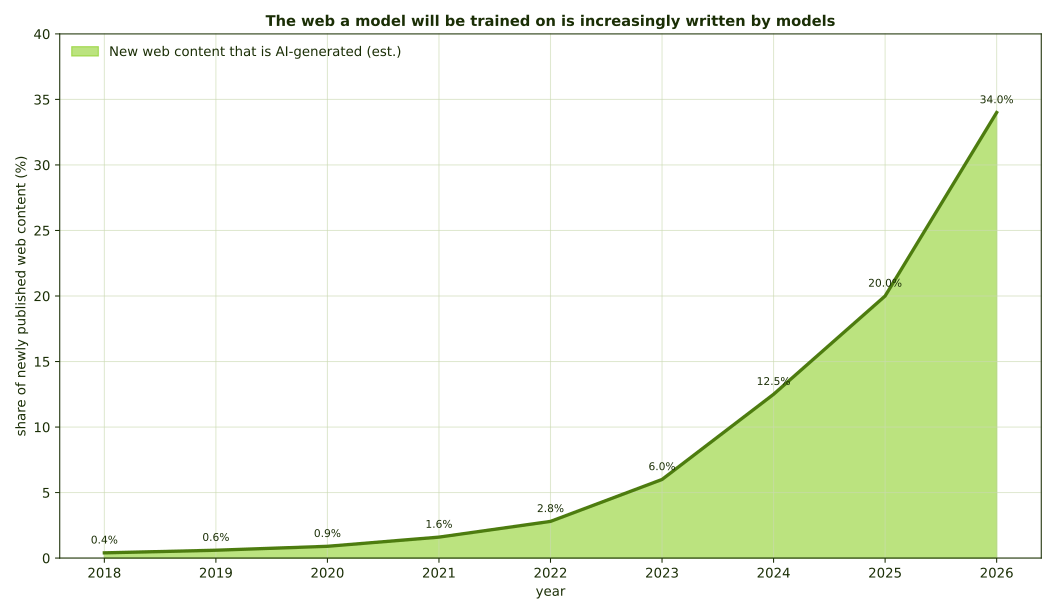
The web a model trains on is increasingly written by models.
This is the mirror of the problem I wrote about last time, when we talked about models that don't know what they don't know and swear to it anyway. The recycling of generated text makes that worse. A model trained on recycled confidence doesn't just hallucinate. It hallucinates in loops.
The synthetic frontier
So what does the industry do about a finite stock of human signal? It starts making data. Not mock data, not fake rows on a spreadsheet, but synthetic data: high-quality training material generated programmatically and fed back into the models as if it were written by a person.
Here's what the people doing this will tell you plainly: it's a very hard problem. Compute is easy to buy. Data that matches the quality of human creation is uncharted territory. Gold-standard human text is rare because the humans who can produce it are rare. You can synthesize a million mediocre tokens in an afternoon. You can't synthesize one true Fields-Medalist reasoning step by pressing a button.
What you can do, though, is run the frontier techniques yourself. The tools the frontier labs are shipping (scalable synthetic pipeline tools, self-instruction loops, open distillers) run fine on Linux against released open weights. The gate is not "do you own a data center." The gate is a judgment about what is worth training on. That is a data-engineering skill, not a hardware one.
The wisdom ceiling
And this brings us to the line from the research that I keep thinking about. Paraphrasing many interviews with data teams in 2026:
"There are very few humans on Earth who can create the data that would make a model better than a Nobel Prize winner or a Fields Medalist. So how do you collect that?"
Flip it around. The whole assumption behind scaling was that more data makes better models. But if better data is the scarce input (data possessed by only the world's elite thinkers or by an entire team's collective workflow) then the bottleneck for "superhuman" AI isn't speed or memory.
The bottleneck is wisdom. The bottleneck is the fact that you can't scrape what was never written down and what only a handful of people on Earth can produce.
The hikmah I can't get out of my head
In Arabic, ʿilm is knowledge and hikmah is something deeper. Wisdom, the right placing of what you know. Most of the machine in modern AI runs on knowledge: text, tokens, patterns, next-word probabilities. All of it is transferable and all of it can be scraped.
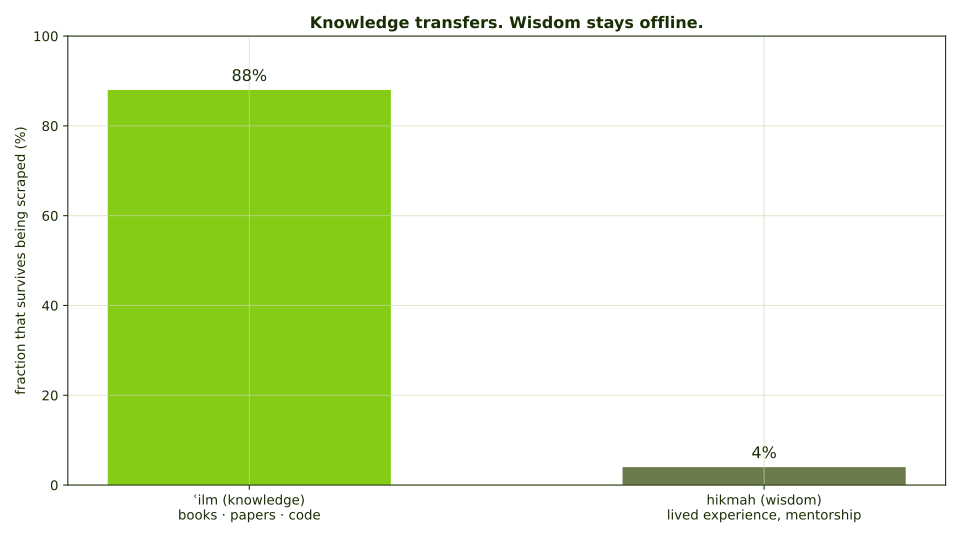
Knowledge transfers. Wisdom stays offline.
Wisdom is not scrapable. It lives offline, in lived experience, in disciplined study, in people who spent years doing a thing extraordinarily well and never posted about it. The kind of text that shaped the better parts of a civilization was never tokenized into a dataset. It was a tradition of mentorship, an unbroken chain of practice, an understanding passed down with care. Giant volumes of it never written down at all.
That's the humbling part. You can funnel every capable engineer's output into one model and it will build the web for you. But if you want to make it wise at the highest level the ceiling isn't a GPU shortage. The ceiling is that nobody manufactured physics theorems as data in bulk. It was discovered, distilled and kept in the heads of the few. Honored precisely because it wasn't commodified.
So when I hear "AI will run out of data," my first instinct as an engineer is to reach for a synthetic data generator. But I don't believe synthetic data alone is the fix. A generator can only remix what the model already holds. It pads the top of the funnel without touching what sits underneath and what sits underneath never got tokenized in the first place. My second instinct, as the person who runs this blog about bridging data and hikmah, is to sit with the question differently.
The machine will not run out of data the way a mine runs out of ore. It will run out the way a well runs dry when the aquifer beneath it empties. And the fix isn't to scrape harder. The fix is to build better data on top of the wisdom that was never captured. It's the same trap as the recycled web. You generate a million tokens and the model learns its own output back. The stock of wisdom didn't grow by one token.
Closing
The frontier of AI data isn't a button. It's a set of questions about who we trust, what we keep and who we train on. Honest and careful. No shortcut exists.
This tie in with the degradation I described in an earlier post on hallucination: if a machine doesn't know what it doesn't know, wait until it's trained on nothing but its own recycled, confident wrongness.
والله أعلم
References
- Alibaba AI models hit 3 billion downloads, passing Meta, Google. Bloomberg via Fortune, Aug 2026: fortune.com. Primary data: Hugging Face, State of Open Models: Summer 2026: huggingface.co/blog/state-of-open-models-summer-2026
- The finite stock of human-generated text: Villalobos et al., Will we run out of data? Limits of LLM scaling based on human-generated data (Epoch AI, 2024): epoch.ai. About 300T effective tokens, fully utilized between 2026-2032.
- Model collapse from recursively trained data: Shumailov et al., Nature 631:755-759 (2024): nature.com/articles/s41586-024-07566-y. Scaling-law framing: Dohmatob et al., A Tale of Tails, ICML 2024: arxiv.org/abs/2402.07043. Severity is debated: arxiv.org/abs/2410.12954
- AI-written share of the web: over 30% of text on active pages and approaching 40% (arxiv.org/abs/2504.08755). ~35% of newly published sites AI-assisted by mid-2025 (arxiv.org/abs/2604.26965). Over 50% of new articles primarily AI-generated since Q1 2025, Graphite: graphite.io
- Elite-knowledge data collection in practice: Epoch AI's FrontierMath problems are sourced from top mathematicians via Signal (lims.ac.uk). 2026 Fields Medalist Jacob Tsimerman joined OpenAI (The Atlantic: theatlantic.com). See also Sara Hooker, On the Slow Death of Scaling (2025): dx.doi.org/10.2139/ssrn.5877662
- Saḥīḥ al-Bukhārī 100 (agreed upon, cf. Muslim 2673): hadithunlocked.com/bukhari:100